Calorimetry: All Basics about Heat Exchange
You have likely noticed that metal feels colder than wood at the same room temperature—but why? Even though I’m sure you’re aware of the phenomenon of Calorimetry from your Class 10 prep, what is it actually, apart from a boring textbook definition?
Hear me out. Anyone who has survived a winter morning in India knows the “bracing” shock of touching a steel gate versus a wooden door. It’s not that the metal is actually at a lower temperature—they’ve both been sitting in the same air all night—it’s just that the metal is much more aggressive at stealing your warmth. Metal is a “heat-thief,” while wood is a “heat-hoarder.”
In real life, calorimetry is the study of that energy on the move. It’s a silent, invisible hand constantly pushing heat from “warm” to “cold” until everything reaches a truce. Think of it less like a chapter of formulas and more like a map of how the universe balances its books.
Heat vs. Temperature: The Great Confusion
Before we dive into the math, let’s clear up a massive misunderstanding. People often use “heat” and “temperature” as if they’re twins, but in physics, they aren’t even distant cousins. Using the right vocabulary isn’t just a “silver bullet” for exams; it’s a predictive signal that you actually understand the mechanics of the universe.
- Heat ( Q ): This is the internal energy being transferred. Its like the “cash” moving between bank accounts. We measure it in Joules ( J ) or calories ( cal ).
- Temperature: This is just a snapshot of how “excited” the molecules in a body are. A thermometer measures it directly, almost like a speedometer for atoms.
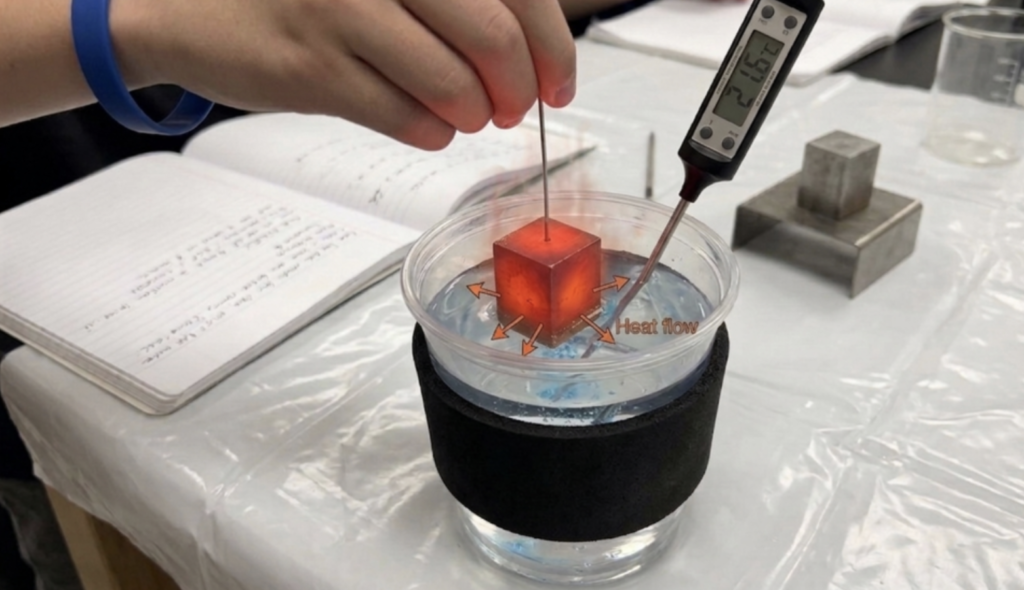
Imagine dropping a glowing red metal bolt into a bucket of chilled water. At first, the difference is bracing. Gradually, the bolt surrenders its energy and the water absorbs it. The system quietly adjusts until both share the exact same temperature. This state of “thermal truce” is what science folks call thermal equilibrium.
The “Personality” of Matter: Specific Heat Capacity
Not all substances react to heat the same way. Water is stubborn; it takes a massive jolt of energy to nudge its temperature up even one degree. Copper, on the other hand, is sensitive and heats up in a flash.
In physics, we don’t just say a substance is “stubborn”—we use the precise term Specific Heat Capacity (c). This is the amount of heat energy required to raise the temperature of a unit mass of a substance by 1°C (or 1K)
[Where m is mass of an object and is the temperature change]*
The S.I. unit here is . It’s a marker of how much energy a substance can “hold” before it starts getting hot.
The “Body” Perspective: Heat Capacity ()
If you’re talking about the entire body (like a whole copper pot rather than just a gram of copper), we use Heat Capacity ( ). This is the heat required to raise the temperature of the whole object by .
Think of Specific Heat as the “price per gram” and Heat Capacity as the “total bill.”
The Golden Rule: The Principle of Method of Mixtures
The heart of your ICSE numericals rests on a beautifully simple law of conservation. This is the “Golden Rule” that assumes your experiment is happening in a perfect world where no heat escapes to the surroundings.
Heat lost by the hot body = Heat gained by the cold body
When you mix a hot substance () with a cold one (), they eventually hit a final equilibrium temperature (). The equation looks like this:
To measure this accurately in a lab, we use a Calorimeter. It is usually a thin copper vessel. Why copper? Because it has a low specific heat capacity (it won’t steal too much of the experiment’s heat for itself) and it’s a great conductor (it reaches the same temperature as the liquid quickly). We nestle it inside an insulating jacket to keep the heat from “leaking” out.
Change of Phase: The “Hidden” Latent Heat
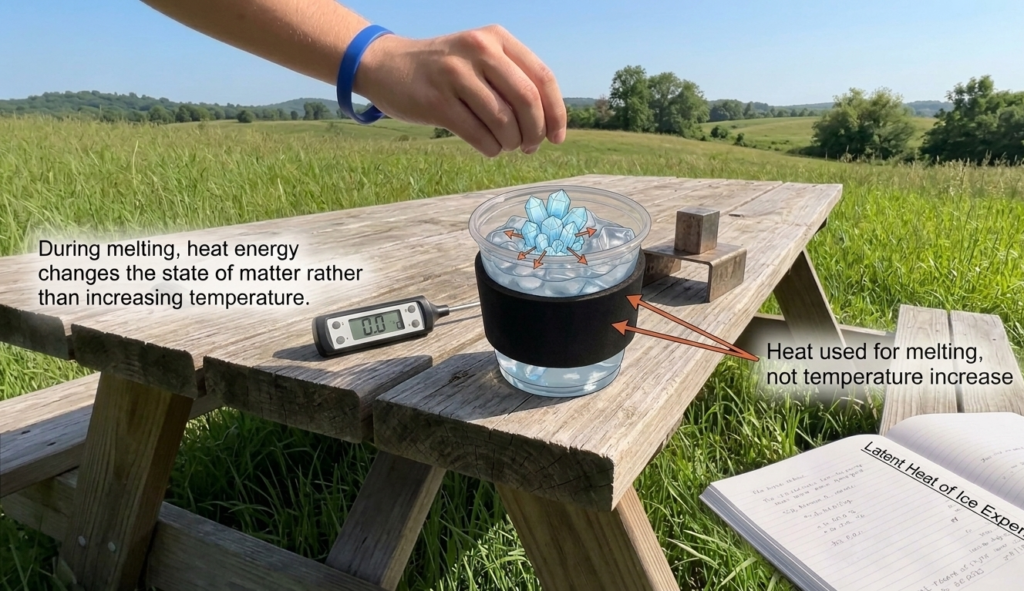
Sometimes, you can pump heat into a substance and the thermometer won’t budge. This feels like a glitch in the matrix—you’re adding energy, but the “speedometer” (temperature) isn’t moving. This is Latent Heat ().
Instead of making the molecules move faster, this energy is being used as a “molecular crowbar” to break the rigid bonds of the solid and turn it into a liquid.
- Specific Latent Heat (L): The heat required to change the phase of a unit mass without a change in temperature.Q = mL
- Fusion of Ice: It takes (or ) just to melt ice. This is a massive amount of “hidden” energy.
- Vaporization of Steam: It takes a staggering (or 540 cal/g) to turn water into steam.
The “Hoo-ah!” Factor: This is why a burn from steam is a total shock to the system compared to a splash of water. The steam is carrying that extra 2,260,000 of latent heat per kilogram. It’s like a good slap on the back right when you aren’t expecting it.
Natural Phenomena: Why ICSE Loves These Questions
Why do we spend hours on these formulas? Because they explain the world around us. These are the reasoning questions that appear year after year:
- Water as a Coolant: Because water has an exceptionally high specific heat capacity (), it can absorb massive amounts of heat without its own temperature skyrocketing. This makes it the “go-to comfort” for car radiators and industrial plants.
- Climate Regulation: Ever enjoyed a sea breeze? Land heats up and cools down faster than the sea because land has a lower specific heat capacity. During the day, the land gets hot, the air above it rises, and the cool “high-specific-heat” air from the sea rushes in to take its place.
- Ice vs. Water as a Coolant: Bottles of soft drinks are cooled more effectively by ice at than by water at . Why? Because every of ice takes an additional of heat from your drink just to melt. It’s a more efficient “heat-thief.”
- The “Bracing” Cold of Melting Snow: When snow starts to melt, the surroundings become incredibly cold. This is because the melting snow “sucks” the latent heat of fusion from the air around it.
Quick Calculation Checklist: How to Ace the Numericals
Precision matters. If you want to articulate yourself using that “math language,” follow these steps:
- Check Your Units: This is where 90% of students lose marks. Ensure mass is in kg if you are using , or in g if you are using Don’t be “hard-headed”—convert them early!
- Temperature Change (): Always use (Higher T – Lower T). This keeps your value positive and your math clean.
- The Phase-Change Trap: If the question involves ice at turning into water at , you need three steps:
- Heat ice to
- Melt the ice ()
- Heat the water to ()Total Q =
A Final Thought: From Us
Calorimetry isn’t just a chapter of formulas and lab measurements. It is the reason engineers can design refrigeration systems that actually work, why a “Citron Chaud” stays hot in a ceramic mug, and how the planet regulates its own fever.
When you look at the formulas, don’t just see letters and numbers. See the direction of the flow. Ask yourself: Where is the heat coming from? Who is losing? Who is winning? Once you visualize the “thermal tug-of-war,” the physics stops being a battle and starts being second nature.
Keep exploring, keep questioning, and keep the “Reason Orbit” moving.
The “Reason Orbit” Technical Note
A Note on Examination Precision: > While the values and formulas provided here align with standard ICSE Class 10 physics (such as 336,000 J/kg for the latent heat of ice), please note that specific constants can vary slightly between different textbook editions (e.g., Concise vs. Selina). In your 2026 Board Examinations, always prioritize the specific values provided in the “Given” section of your question paper to ensure 100% numerical accuracy.