
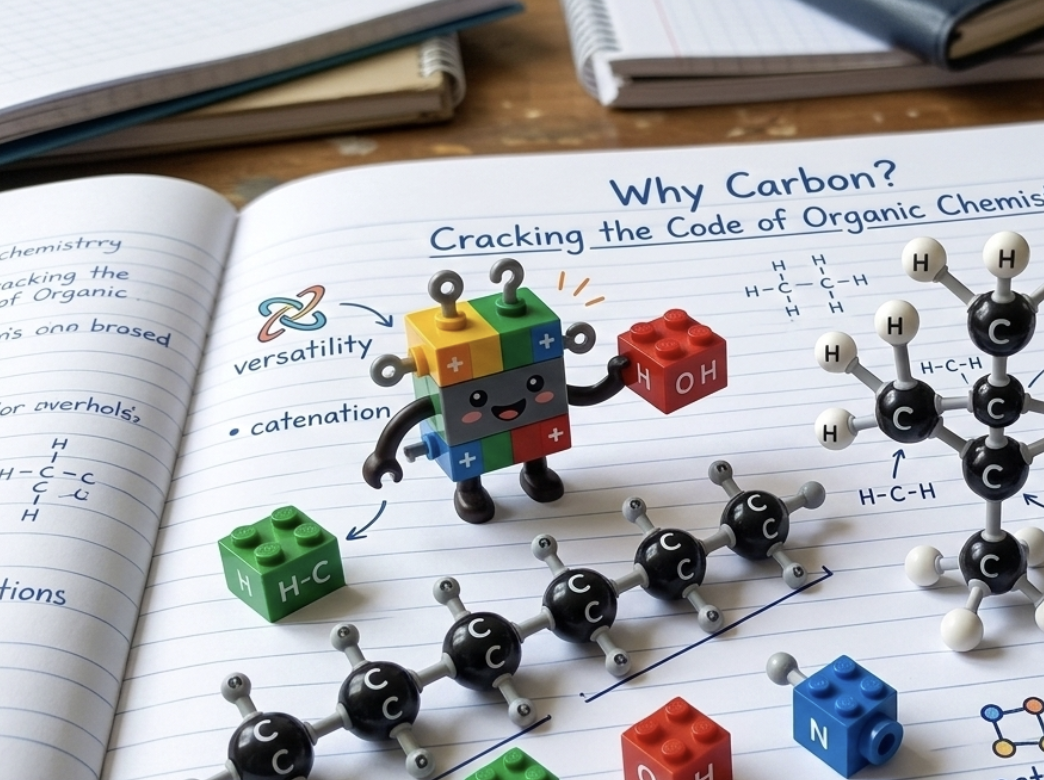
Are you also the victim of Organic Chemistry? Don’t worry you’re not uncommon. Now lets cook organic chemistry together.
If you’ve opened your ICSE textbook to “Organic Chemistry” and felt a bit overwhelmed by the sea of CH4, C2H6, and C2H4, you aren’t alone. It looks like a dense forest of symbols, but there’s a secret to it: Organic chemistry isn’t about memorizing a phone book of reactions. It’s actually the study of molecular architecture.
Once you understand how carbon “thinks,” the patterns start to reveal themselves.
The Ultimate Team Player: Why Carbon is So Knave?
Think of the carbon atom as the “LEGO brick” of the universe. It has four valence electrons, which is a fancy way of saying it has four “hooks” ready to grab onto other atoms.
What makes carbon truly special, though, is a property called catenation. Essentially, carbon is a self-obssed element. It can link up with other carbon atoms to build:
- Straight chains (like a long pearl necklace)
- Branched chains (like a tree)
- Cyclic structures (like a closed ring)
Whether it’s a tiny molecule like Methane (CH4) or a massive framework found in plastics or DNA, it all starts with those four simple bonds.
Stop Mugging Up, Start Imagining
The biggest “aha!” moment for most students happens when they stop looking at formulas and start looking at structures. Take a look at these three common molecules:
- Ethane: Carbons connected by a single bond (sturdy and stable).
- Ethene: Carbons sharing a double bond (a bit more “tense” and reactive).
- Ethyne: Carbons locked in a triple bond (highly energetic).
That single, double, or triple line between the atoms isn’t just a drawing—it’s a roadmap for how the molecule will behave. A triple bond is like a spring under tension; it wants to react. Once you see the bonds, the chemical reactions stop looking like random rules and start making logical sense.
The Big Family of Chemistry: Hydrocarbons
In the ICSE syllabus, we start with the basics: Hydrocarbons (molecules made of only Carbon and Hydrogen). Think of these as the “base models” of organic chemistry.
- Saturated (Alkanes): These molecules are “full.” Every carbon bond is a single bond, holding as many hydrogens as possible. They follow a predictable pattern: CnH2n+2.
- Unsaturated (Alkenes & Alkynes): These have double or triple bonds. Because they aren’t “full” of hydrogens, they are much more eager to jump into reactions.
The “Command-C & Command-V” Pattern: Homologous Series
The coolest thing about organic chemistry is that it’s repetitive. A Homologous Series is just a family of compounds that grows by a predictable amount—specifically a CH2 unit.
If you know how Methane behaves, you can make a very educated guess about how Butane behaves. It’s like learning the rules for one level of a video game and realizing those same rules apply to every level after it.
Adding Personality: Functional Groups
Organic chemistry gets really interesting when “outsiders” join the carbon chain. We call these Functional Groups. They are the “special features” that change a molecule’s entire personality.
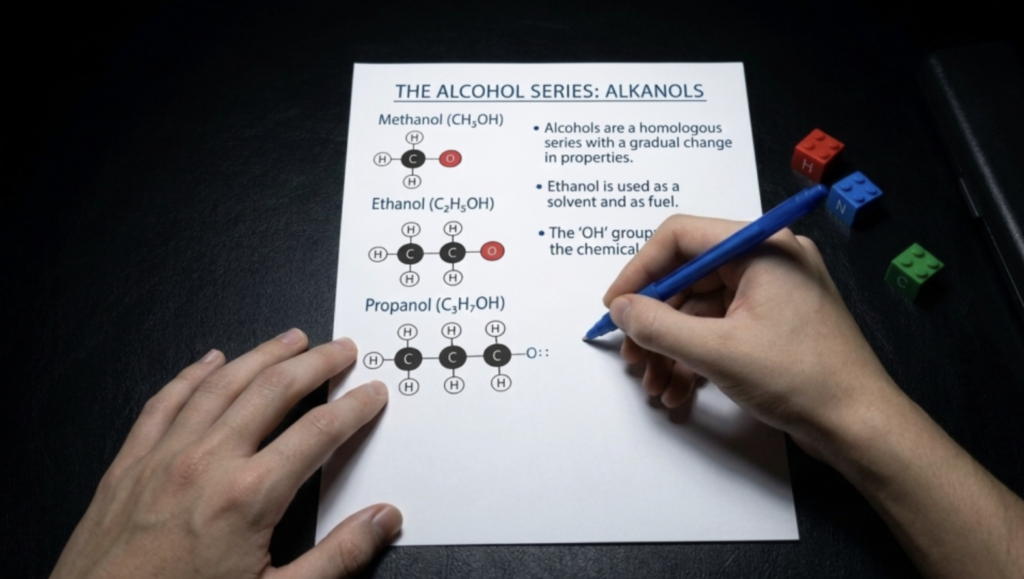
- The Alcohol Group (–OH): Add this to a chain, and you get Ethanol—used in everything from fuels to hand sanitizers.
- The Carboxyl Group (–COOH): This turns a simple chain into an acid, like the Acetic Acid you find in your kitchen vinegar.
Why This Actually Matters
It’s easy to get lost in the textbook, but organic chemistry is the reason you’re alive. It’s in the fuel in your car, the medicine in your cabinet, the scent of your perfume, and the proteins in your muscles.
The ICSE chapter isn’t just a hurdle to pass your exams; it’s your first real look at the invisible engineering that builds the world around us.

Leave a Reply